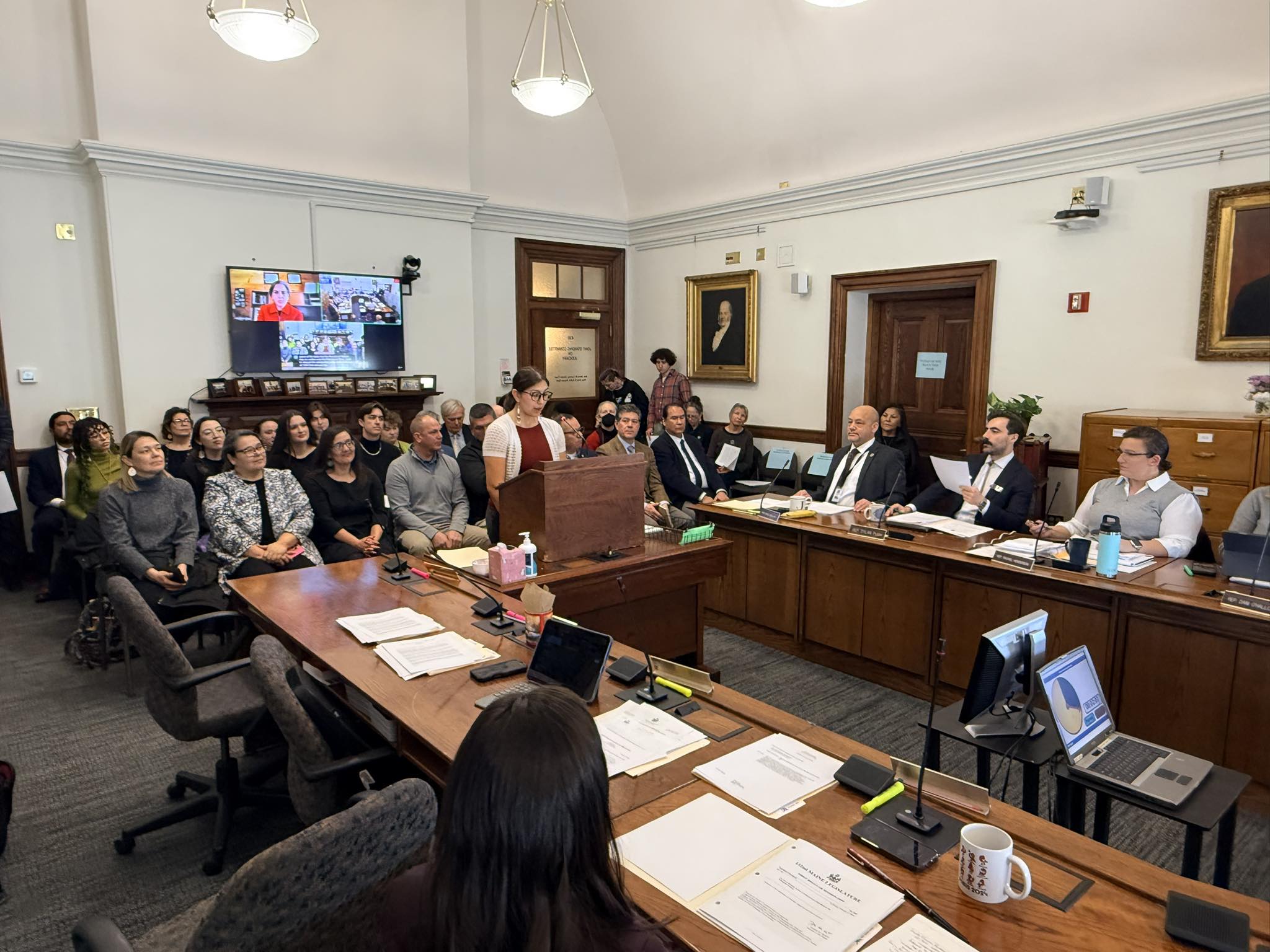
Carmella Ipimin, a citizen of the Penobscot Nation, testifies in support of two bills to expand Wabanaki sovereignty during a public hearing on February 19, 2026.
Public hearings at the Maine State House on February 19 drew oral and written testimony from hundreds of Wabanaki citizens and allies who support two bills to expand Wabanaki sovereignty.
Nearly 500 pieces of written testimony were submitted to the Judiciary Committee in support of LD 785, a bill to protect Wabanaki rights by restoring tribal self-government to tribes in Maine, and LD 395, which would extend to the Wabanaki Nations most existing and future federal laws that already apply to the other 570 federally recognized tribes.
Both bills are based on consensus recommendations from a bipartisan task force convened by the Maine Legislature to address long-standing issues with the Maine Indian Claims Settlement Act and the state Maine Implementing Act, which passed in 1980 and govern the relationship between the state and The Houlton Band of Maliseet Indians, Mi’kmaq Nation, Passamaquoddy Tribe, and Penobscot Nation.
Known collectively as the Settlement Acts, the legislation allows Maine to exert an unusual level of jurisdiction over tribal affairs not found in any other state. For more than 40 years, the state of Maine has used the Settlement Acts to deny Wabanaki Nations’ authority to self-govern, a position in direct conflict with the foundations of Federal Indian Law.
“We are so pleased with the turnout for the hearing and outpouring of support from Tribal Chiefs, lawmakers and dignitaries, students and youth, and so many allies and friends from our coalition of supporters,” said Maulian Bryant, citizen of the Penobscot Nation and executive director of the Wabanaki Alliance. “Mainers are ready for improvements for the Wabanaki people and they know it will benefit our whole state.”
Support for LD 785 and LD 395 comes from every county in Maine, from people of all political parties, from rural and urban communities, from elected officials in local, state, and national government, and from the more than 300 nonprofit, faith-based, and racial and social justice organizations that are working in partnership with tribal leaders and citizens through the Wabanaki Alliance Coalition.
The Judiciary Committee will schedule work sessions soon to continue discussion of both bills, before sending them to Maine House and Senate for a vote later this session.
Learn more about these bills and how you can support them in our Take Action Toolkit. You can also read the public testimony for LD 395 and LD 785.
Media coverage of the public hearings
-
- Lawmakers again consider returning more sovereignty to Wabanaki Nations, Maine Morning Star, February 19
- Tribal chiefs press Maine lawmakers for progress, Spectrum News, February 19
- Wabanaki Nations, Mills are finding common ground, Portland Press Herald, February 19
- Mills administration, Wabanaki tribes in talks over sovereignty bills, Maine Public, February 19
- Lawmakers hear public testimony on bills that aim to support tribal sovereignty for the Wabanki Nations, WFVX-TV, February 19